How Much Does Medicare Cost in Nebraska in 2026?
Table of Contents
Medicare isn't one flat fee. What you pay in Nebraska depends on which parts of Medicare you have, how much income you report, and what type of supplemental coverage you choose. Some costs are set by the federal government and apply the same everywhere. Others, especially Medigap and Medicare Advantage premiums, vary by location, insurer, and plan type.
This guide breaks down every major Medicare cost for Nebraska residents in 2026 so you can see the full picture in one place. Part A, Part B, and Part D figures below reflect the standard 2026 rates published by the Centers for Medicare & Medicaid Services (CMS), which are also summarized on the official Medicare.gov costs page. Medigap and Medicare Advantage costs are set by private insurers and can differ inside Nebraska.
Medicare Part A Costs in Nebraska in 2026
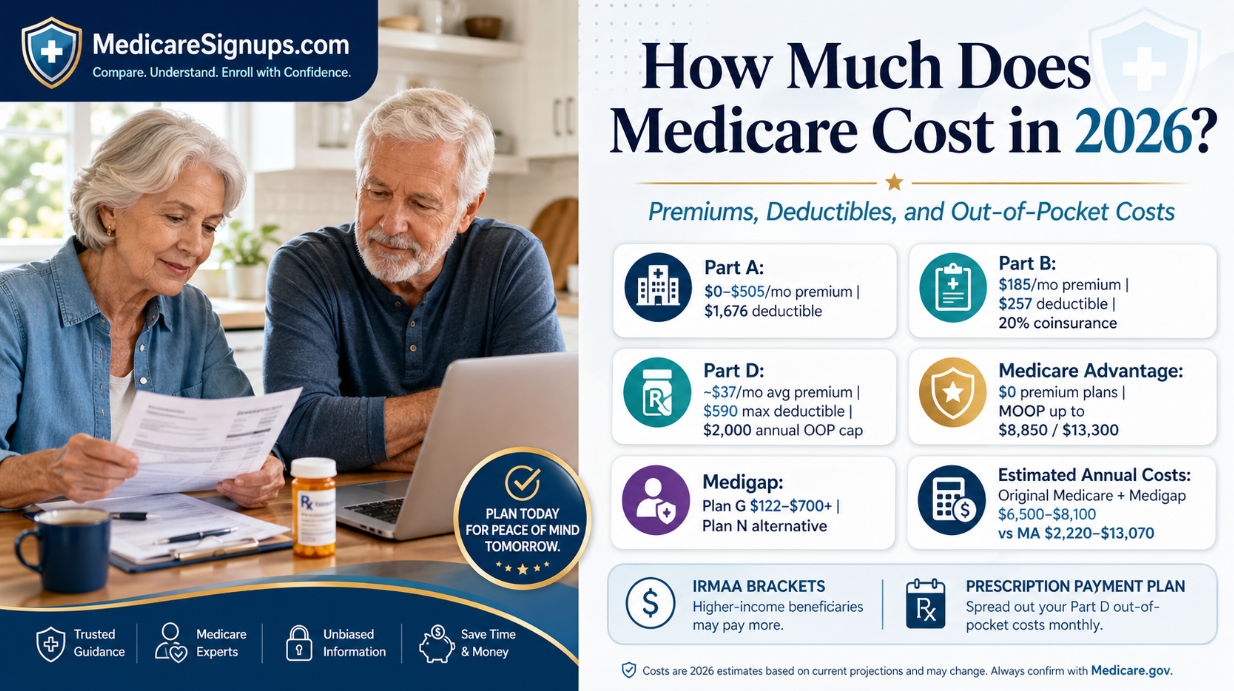
Medicare Part A covers inpatient hospital stays, skilled nursing facility care, hospice, and some home health services. Part A costs are set federally and apply the same whether you live in Nebraska or anywhere else in the country.
Part A Premium
If you or your spouse paid Medicare taxes for at least 40 quarters (10 years), you qualify for premium-free Part A. That covers the vast majority of Nebraska beneficiaries.
If you don't meet that threshold:
- 30-39 quarters of work history: $278 per month
- Fewer than 30 quarters: $505 per month
Part A Deductible
The Part A deductible is $1,676 per benefit period in 2026. A benefit period starts the day you're admitted as an inpatient at a hospital in Nebraska and ends when you've been out of the hospital or skilled nursing facility for 60 consecutive days. If you're readmitted after that 60-day window closes, you pay the deductible again.
There's no limit on how many benefit periods you can have in a year, which means Nebraska residents could pay this deductible multiple times if they have repeated hospital stays.
Hospital Coinsurance
After you meet the deductible, Part A covers your hospital stay, but coinsurance kicks in for longer stays:
- Days 1-60: $0 coinsurance (fully covered after deductible)
- Days 61-90: $419 per day
- Days 91-150 (lifetime reserve days): $838 per day. You get 60 lifetime reserve days total, and they don't renew.
- Beyond 150 days: You pay all costs
Skilled Nursing Facility Coinsurance
If you need skilled nursing care in Nebraska after a qualifying hospital stay:
- Days 1-20: $0 coinsurance
- Days 21-100: $209.50 per day
- Beyond 100 days: You pay all costs
Medicare Part B Costs in Nebraska in 2026
Medicare Part B covers doctor visits, outpatient procedures, lab tests, durable medical equipment, preventive screenings, and mental health services. Unlike Part A, every NE resident on Medicare pays a monthly premium for Part B.
Part B Premium
The standard Part B premium is $185 per month in 2026. Most Nebraska beneficiaries have this deducted directly from their Social Security check.
Higher-income beneficiaries pay more through the Income-Related Monthly Adjustment Amount (IRMAA). The Social Security Administration uses your tax return from two years prior (2024 income for 2026 premiums) to determine your bracket:
| Individual Income | Joint Income | Monthly Premium |
|---|---|---|
| $106,000 or less | $212,000 or less | $185.00 |
| $106,001 - $133,500 | $212,001 - $267,000 | $259.00 |
| $133,501 - $167,000 | $267,001 - $334,000 | $370.00 |
| $167,001 - $200,000 | $334,001 - $400,000 | $480.90 |
| $200,001 - $500,000 | $400,001 - $750,000 | $591.90 |
| Above $500,000 | Above $750,000 | $628.90 |
If your income has dropped since then due to a life-changing event (retirement, death of a spouse, divorce), you can file SSA Form 44 to request a new determination based on your current income. Certain Medicare decisions can also affect your taxes, so it's worth understanding how IRMAA and income interact.
"If your income drops because of a life-changing event, for example, if you reduce your hours or retire and that brings your income to a much lower level than it was two years ago, you can often file what's called a redetermination," says Andrew Firmin, a licensed Medicare agent in Massachusetts. "Basically, this indicates to Medicare and Social Security, 'Hey, I am no longer working, and therefore I'm not earning the same amount I was two years ago.'" Firmin notes the redetermination is the most direct path back to the standard premium when retirement drops your income.
Part B Deductible
The annual Part B deductible is $257 in 2026. After you meet it, you pay 20% coinsurance on most Part B services. That 20% has no annual cap under Original Medicare, which is one of the main reasons Nebraska residents buy supplemental coverage.
Part B Late Enrollment Penalty
If you don't sign up for Part B when you're first eligible and you don't have qualifying employer coverage, you'll pay a late enrollment penalty of 10% for every 12-month period you delayed. This surcharge is permanent and gets added to your monthly premium for as long as you have Part B.
Medicare Part D Costs in Nebraska in 2026
Medicare Part D provides prescription drug coverage through private insurance plans. Costs vary more here than in any other part of Medicare because each plan sets its own premium, formulary, and copay structure. Available plans and pricing differ by county across Nebraska.
Part D Premium
There's no single Part D premium. Plans set their own rates, and prices vary by region. The national base beneficiary premium for 2026 is approximately $36.78 per month, but actual plan premiums available to NE residents range from under $10 to over $100 per month depending on coverage level and pharmacy network.
IRMAA surcharges apply to Part D as well. Higher-income beneficiaries pay an additional $13.70 to $81.00 per month on top of their plan premium, using the same income brackets as Part B.
Part D Deductible
The maximum allowable Part D deductible in 2026 is $590. Many plans available in Nebraska set their deductible lower than this, and some waive it entirely for certain drug tiers (typically generic and preferred brand-name drugs).
The $2,000 Out-of-Pocket Cap
Starting in 2025, the Inflation Reduction Act capped annual out-of-pocket drug spending at $2,000. This cap continues in 2026 and replaces the old coverage gap (donut hole) structure where costs could spiral much higher.
Once you hit $2,000 in total out-of-pocket drug costs for the year, you pay nothing more for covered prescriptions for the rest of that calendar year. Nebraska beneficiaries can also use the Medicare Prescription Payment Plan to spread their out-of-pocket drug costs into predictable monthly installments instead of paying large amounts at the pharmacy counter. Learn more about how the $2,000 cap works.
"This allows you to set up a monthly payment plan directly with your Part D insurance company, where you pay a set monthly payment instead of experiencing the deductible all at once in January or February," says Erlynne Massie, a licensed Medicare agent in Arizona. "This allows for simple, budgeted, plannable medication costs." Massie notes that beneficiaries need to contact their Part D insurer directly to enroll — the plan isn't automatic.
Part D Late Enrollment Penalty
Similar to Part B, there's a penalty for going without creditable drug coverage. The Part D late enrollment penalty is 1% of the national base premium ($0.37 in 2026) for every month you were eligible but didn't have creditable coverage. Like the Part B penalty, it's permanent.
Medicare Advantage (Part C) Costs in Nebraska in 2026
Medicare Advantage (Part C) plans are offered by private insurers and must cover everything Original Medicare covers. Many plans include Part D drug coverage and extras like dental, vision, and hearing. The number of available plans, premiums, and benefits vary significantly across Nebraska counties.
Medicare Advantage Premiums
Many Medicare Advantage plans in Nebraska charge $0 in additional monthly premiums beyond what you already pay for Part B. Some plans with richer benefits charge $20-$100+ per month. You still pay your Part B premium regardless.
"Zero-premium sounds like 'free Medicare,' but it's not zero-cost. It's more like a cell phone plan with a $0 monthly fee until you start using data, minutes, or roaming," says James Hale, a licensed Medicare agent in Georgia. He shared a recent example: "Last year I had a client with a $0 premium plan. He thought his heart procedure would cost almost nothing. Between the hospital copay, specialist visits, and rehab, he still paid over $4,000 out of pocket that year." The takeaway, according to Hale, is that zero-premium plans shift costs from monthly bills to the moments you actually use care.
Copays and Coinsurance
Instead of the flat 20% coinsurance of Original Medicare, Advantage plans use a mix of copays and coinsurance that vary by service type. A typical plan in Nebraska might charge:
- Primary care visit: $0-$20 copay
- Specialist visit: $25-$50 copay
- Urgent care: $20-$65 copay
- Emergency room: $50-$120 copay (waived if admitted)
- Inpatient hospital stay: $200-$400 per day for the first several days
These are examples. Every plan sets its own cost-sharing, so the only way to know your exact costs is to review the plan's Evidence of Coverage document or compare plans using a financial checklist.
Maximum Out-of-Pocket (MOOP)
The biggest structural difference from Original Medicare: Advantage plans have an annual out-of-pocket maximum. For 2026, CMS sets the ceiling at $8,850 for in-network services and $13,300 for combined in-network and out-of-network services. Many Nebraska plans set their MOOP lower than these limits.
Once you hit your plan's MOOP, the plan covers 100% of your Medicare-covered services for the rest of the year. Original Medicare has no equivalent protection, which is why this cap is a major selling point for Advantage plans.
"The fact that original Medicare does not have an MOOP annual limit is a financial risk nobody should take, especially since you can enroll in a zero-dollar Medicare Advantage plan premium which must, by federal law, be as good as original Medicare," says Mark Zaruba, a licensed Medicare agent in Wisconsin. "With this you can also have a drug plan in place to keep you from the Part D late enrollment penalty." His point: going without either a Medigap plan or a Medicare Advantage plan leaves your 20% Part B exposure completely uncapped.
Medigap (Medicare Supplement) Costs in Nebraska in 2026
Medicare Supplement plans are designed to cover the cost-sharing gaps in Original Medicare: the deductibles, coinsurance, and copays that Part A and Part B don't pay. They only work with Original Medicare, not with Medicare Advantage.
Medigap Premiums in Nebraska
Medigap premiums vary significantly based on:
- Plan letter (G, N, and others each cover different gaps)
- Your age
- Where you live in Nebraska
- The insurance company
- The pricing method (community-rated, issue-age, or attained-age)
Plan G is the most popular Medigap plan and covers nearly all out-of-pocket costs under Original Medicare except the Part B deductible ($257/year). Plan G prices vary widely by location, with monthly premiums in 2026 ranging from roughly $122 to over $400 depending on your metro area and age. Some high-cost regions exceed $700.
Plan N is a lower-premium alternative that requires small copays ($20 for some office visits, up to $50 for ER visits that don't result in admission) and doesn't cover Part B excess charges.
What Medigap Doesn't Cover
No Medigap plan covers prescription drugs. If you choose Original Medicare with a Medigap plan in Nebraska, you'll need a standalone Part D plan for drug coverage.
Putting It All Together: What Will Nebraska Residents Actually Pay?
Your total Medicare costs depend on which coverage path you choose. Here are two common scenarios to illustrate the range:
Side-by-Side: Original Medicare + Medigap vs. Medicare Advantage in Nebraska
| Cost Component | Original Medicare + Plan G + Part D | Medicare Advantage (with drugs) |
|---|---|---|
| Part B premium | $185/month | $185/month |
| Plan premium | Medigap G: ~$150-$250/mo (varies by location in Nebraska) Part D: ~$15-$50/mo |
$0-$50/month (many Nebraska plans are $0) |
| Deductibles | Part B: $257/year (only gap Plan G doesn't cover) | Varies by plan and service |
| Cost-sharing at point of care | Almost none after deductible | Copays/coinsurance per visit |
| Drug out-of-pocket cap | $2,000/year | $2,000/year |
| Medical MOOP | None needed (Plan G covers gaps) | $8,850 in-network |
| Estimated annual total | $6,500 - $8,100 | $2,220 - $13,070 |
| Trade-off | Higher predictable monthly costs, almost no surprise bills | Lower monthly costs, higher exposure when you use care |
Plan G essentially caps your Part A and Part B exposure at $257 per year, so the annual total is narrow and predictable. The Advantage range is wide because how much you pay depends heavily on how much care you use in a given year. Comparing the overall value of each approach can help you decide.
Ways to Lower Your Medicare Costs in Nebraska
Several programs and strategies can reduce what NE residents pay:
- Medicare Savings Programs: If your income and assets are limited, Nebraska may pay some or all of your Medicare premiums and cost-sharing. Programs like QMB, SLMB, and QI cover different levels of assistance. Learn about Medicare Savings Programs.
- Extra Help (Low-Income Subsidy): Helps pay Part D premiums, deductibles, and copays for people with limited income. You can apply through Social Security or the Nebraska Medicaid office.
- Medicare Prescription Payment Plan: Doesn't lower your total drug costs, but spreads them into even monthly payments so you don't face large pharmacy bills early in the year.
- IRMAA appeals: If a life-changing event reduced your income, file SSA Form 44 to request lower premiums.
- Compare plans annually: Drug plan formularies, premiums, and pharmacy networks change every year in Nebraska. Reviewing your options during Open Enrollment can save hundreds.
"If you qualify for Medicaid, it can go along with your Medicare. This is referred to as dual-eligible (Medicare and Medicaid). Dual eligible individuals qualify for additional benefits," says Daniel Greer, a licensed Medicare agent in Michigan. "There is another program for low-income folks called Extra Help for Prescription Drug Costs. The income brackets for this program are slightly higher than those for Medicaid. Some folks qualify for Medicare, Medicaid and Extra Help for Prescription Drug Costs."
The Bottom Line on Medicare Costs in Nebraska for 2026
The floor for Medicare spending is roughly $2,220 per year (just the Part B premium with a $0-premium Advantage plan and minimal care usage). The ceiling depends on your health, your coverage choices, and your income.
For most Nebraska beneficiaries, the real question isn't just "how much does Medicare cost" but "how much financial risk am I comfortable with?" Original Medicare with Medigap gives you predictability. Medicare Advantage gives you lower monthly costs but more exposure per-service. Neither path is universally better. The right one depends on your health needs, your budget, and how you feel about out-of-pocket variability.
If you're approaching 65 in Nebraska or already on Medicare and want to review your options, a local Medicare agent can walk you through the specifics for your area at no cost to you.

Heather McDaniel
Licensed Nebraska Medicare Agent
Contact Heather through Medicare Agents Hub »